
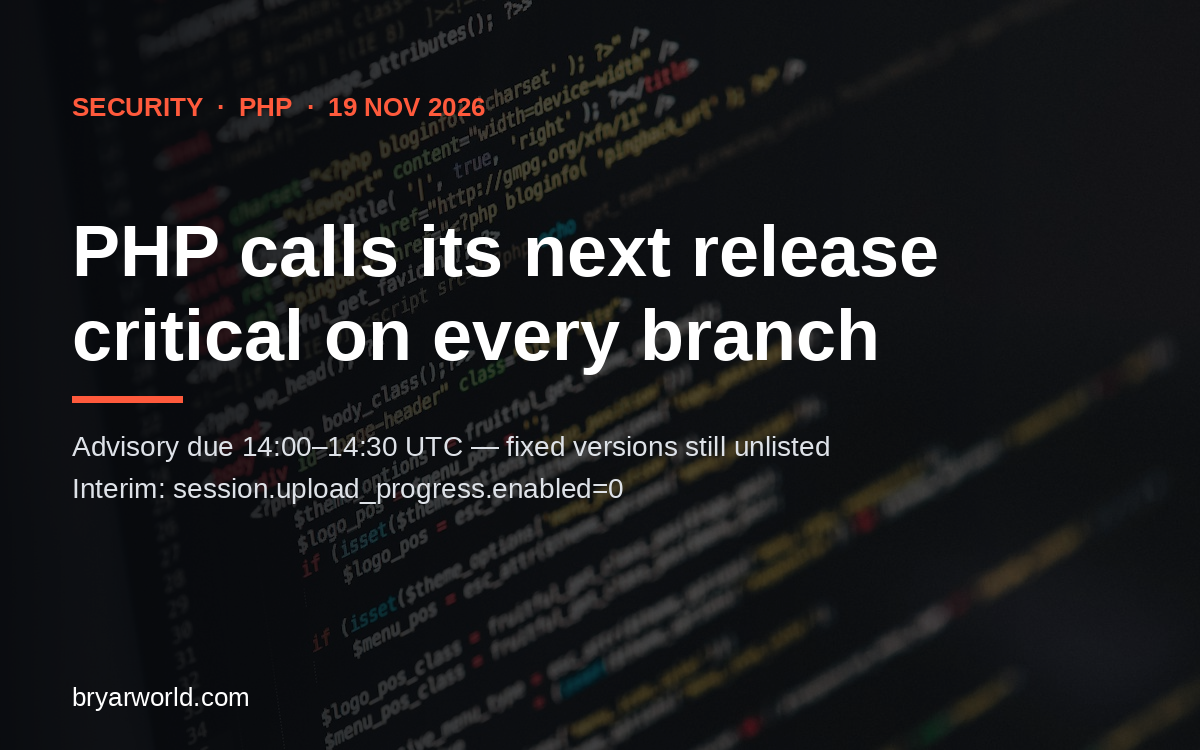
PHP’s security team posted an advisory on 18 November warning that its next scheduled release, due Thursday 19 November between 14:00 and 14:30 UTC, will fix vulnerabilities rated CRITICAL. The release covers all supported PHP versions, and the project says the most serious issues require either a non-default configuration or an uncommon setup.
What the advisory does and does not say
The announcement is deliberately thin. It is part of PHP’s regular four-week cycle, it affects every supported branch, and the highest severity is CRITICAL. Fixed version numbers and technical detail will be published alongside the releases. As of this writing, roughly two and a half hours before the window opens, nothing has been published beyond that notice.
That timing matters for anyone planning a maintenance window. The 14:00 to 14:30 UTC slot is when the tarballs and the security page entries should appear, not when your distribution will have rebuilt packages. Debian, Ubuntu and the various container base images will lag by hours or days, and the lag is where the risk sits for anyone who cannot build from source.
The flaw expected in the release
The Hacker News reports that the update is expected to include CVE-2026-115560, a remote code execution flaw. Its preconditions are specific:
- The application sets
session.serialize_handlertophp_binaryorphp_serializein its configuration. - Its code then switches the handler to
phpwithini_set()before callingsession_start(). - Session upload progress is enabled, which is PHP’s default.
Read that list twice before panicking. The vulnerable state is not “PHP with sessions on.” It needs an application that starts in a binary or serialize handler and then moves to the plain php handler at runtime. That is unusual code, which is consistent with the maintainers saying critical issues need uncommon setups. Plenty of frameworks never touch the handler at all.
The interim mitigation
The suggested stopgap is to set session.upload_progress.enabled=0 and restart the PHP worker so the setting takes effect. If you run PHP-FPM, that means reloading the pool; an Apache module setup needs the server restarted. Upload progress is a niche feature, used mostly by applications that draw a progress bar during large uploads, so most sites can carry that change without noticing it.
Checking where you stand takes one command:
php -i | grep -E 'session.serialize_handler|session.upload_progress.enabled'The machine serving this page runs PHP 8.3.36 with the default php handler, so the precondition above does not apply here. The upload progress setting is on, which is the default and not a problem on its own.
Why this release is being watched closely
PHP had a rough October. A month ago the project fixed CVE-2026-109618 and CVE-2026-109619, together called PHP2Shell: unauthenticated remote code execution through crafted HTTP requests. Those flaws have seen limited active exploitation, aimed at publicly reachable Palo Alto Networks management interfaces and Check Point Security Gateways, with attackers using them to move against Active Directory and plant backdoors. Hunt.io counted 616 PHP2Shell-related files across multiple hosts on 30 October, a mix of exploit kits, cloned proofs of concept, heap exploits and post-exploitation tooling. CrowdStrike’s assessment was that a single universal exploit is unlikely to work across every deployment, which is cold comfort if yours is the one it fits.
The same month brought patches for CVE-2026-111497, an out-of-bounds write in the Brotli decoder library, nicknamed Node2Shell and Broccoli2Shell, that could also lead to arbitrary code execution. Three critical rounds in a few weeks is not a pattern anyone wants to see in a runtime this widely deployed.
What to do today
- Watch php.net’s releases page from 14:00 UTC and read the fixed version numbers before you plan the upgrade.
- Until you patch, set
session.upload_progress.enabled=0and restart the workers. - Audit your codebase for
session.serialize_handler, especially anyini_set()call that changes it beforesession_start(). - Check whether your distribution has backported packages, and compare the full package version rather than the upstream string.
- If you run PHP behind a CDN or WAF, remember those rules were written for the last round of flaws, not this one.
None of this is a reason to rebuild your stack tonight. It is a reason to know whether your applications meet the preconditions, and to have the upgrade path ready before the details land.
Sources: php.net news archive, The Hacker News, Hunt.io and CrowdStrike reporting as cited by The Hacker News.

0 Comments