
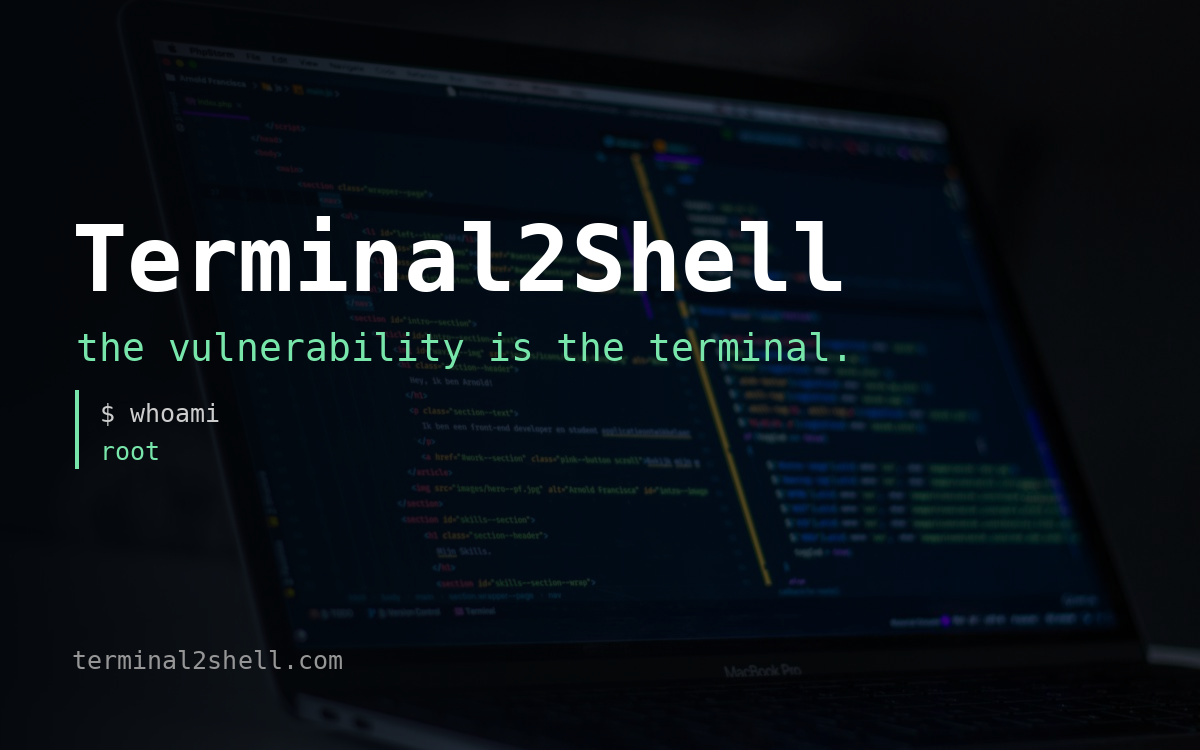
Short version. Terminal2Shell is a parody security advisory. It opens with a red banner, an estimated two billion affected devices, active exploitation and no patch. The vulnerability it describes is that opening a terminal starts a shell and connects it to your keyboard. That is the entire finding. Read it as satire, not as a CVE.
What the page actually claims
It follows the grammar of a real advisory almost perfectly. There is a proof of concept you can type into. There is an affected-systems matrix: macOS, every Linux distribution, Windows, FreeBSD, a DEC VT100 from 1978, your router, VS Code, and Microsoft Paint listed as not affected. There are indicators of compromise, which are prompt characters followed by a blinking cursor, and a note that a hash prompt means the attacker has root.
The mitigations are the best part. Do not open terminals. Close them immediately after opening. Type slower. Remove the keyboard. Set SHELL=/bin/false, which the page notes also removes your ability to use the computer. The disclosure timeline starts in 1971 with the Thompson shell and ends in 2026 with vendors replying that this is what a terminal is.
Why it works as satire
It reproduces the exact structure the industry rewards: a severity banner, a weaponised proof of concept, an affected matrix, indicators, mitigations, a timeline, an FAQ, a logo and a domain. Every element is present and every element is empty, which is the point.
It also sends up the naming convention. Shellshock, Log4Shell, and every recent vulnerability that needed a number and a noun. The page notes that a serious vulnerability needs a name ending in a number followed by a noun, and that this one has all three, so it must be serious.
The sharpest line is the FAQ answer about privilege escalation: the attacker can escalate to root only if they know the password, and in the most common scenario the attacker is the user.
The part that is not a joke
Terminal risk is real, just not this risk. The interesting surface is what a terminal does with bytes it receives rather than the shell it spawns. Escape-sequence injection from untrusted output, OSC 52 writing to your clipboard, hyperlink tricks, and pasting text that you did not read before pressing enter. Those are genuine concerns and they are all about parsing, not about the existence of a shell.
Terminal2Shell works because the exploit primitive it describes is the feature. A shell executes what you type. That is the product, not the bug.
What to take away
- Read past the banner. A severity claim without a mechanism is marketing.
- Ask what the exploit primitive is. Here it is a shell, which is what a terminal is for.
- A logo and a domain are not evidence of anything.
- Real terminal hygiene is boring: do not paste untrusted text into a shell, review escape sequences from remote output, keep the emulator patched.
The page itself is worth five minutes: terminal2shell.com.

0 Comments